It is has been a couple of months since I popped in here. Wow, time flies. Busy busy times at the moment with christmas coming up. For the crafty and creative person comes a-whole-lot-of-stuff-to-do panic around about this time of the year. I took a chill pill the other day and made some decorations for our hallway. I have saved all these fruit netting bags to find a reuse for them and they finally came handy to create this hanging, pagan queen like woman...I love the simplicity of this piece and the best part of this is that I get to eat more ice cream now to get more sticks! This pagan theme is reminding me that I am finally coming to terms with the complexity of my scandinavian heritage and my newfound home in australia...I am working towards embracing both in finding a pathway for my creative streak.
Hanging decoration in hallway
Pagan queen
I also had some scraps lying around after finishing a bouquet arrangement for my friends wedding flowers. I used this awesome (but expensive) hat making mesh and it is quite stiff which makes for great folded flower like shapes with bits of fabric stuck in it.
Fabric flower
It is the first advent on sunday (not that i am very religious but it is a nice custom regardless). Got some christmas decorations up, next on the itinerary are the stockings. Have all the materials, just need to finish the tie I am sowing for my partner for a wedding we are going to next weekend. Pweh, hard life being a maker. (NOT)
oh, ps. YES. We finally moved the TV away from our main living area, the conversations that has enabled over the last week is unreal. Loving it.
Recycle plastic bottle pattern - Image via designboom courtesy of Heath Nash
This project includes all the things that I love about design and more specifically about the urban landscape and meaningful spatial site interventions. Heath Nash, project coordinator and designer produced and organised this work along with local artisans for Harare International Festival of the Art. HIFA performing arts festival 2011. The South-African designer, reused thousands of recycled plastic bottles and other materials such as plastic buckets and aluminium cans to create a set of canopies for the urban dweller to take to when in need of shade. According to designboom, Nash got the inspiration from simply walking the streets of the Zimbabwean capital whilst observing how people occupied and congregated under the city's tree canopies so to avoid the Southern African mercury.
This observation was translated into a pragmatic and spatial take on the idea of recycling waste materials derived from consumption.
Components of an extensive distribution system - Image via designboom courtesy of Heath Nash
The way in which the canopies are constructed is simply magic. Repetitive pattern is one of the most powerful ways of generating beauty and striking form in my eyes and the combining of cultural and social observation with a commentary of mass-consumption, leads way to a meaningful site intervention.
The project suggests a site intervention that is constructed at a 1:1 scale, utilising local craftsmanship with the organising mind of a designer. The other beauty in this project lie in the system that this 1:1 site intervention actually represents. Where all these bottles, cans and buckets come from remain unrepresented, perhaps it is not doable but I hope that you get the picture. A 1:1 intervention that assembles tens of thousands of small objects that was part of a mass-distribution system going out for consumption to then be returned to another system, that of recycling and end up in this meaningful installation. Simply beauty.
re-ordering, re-assembling, re-configuring- Image via designboom courtesy of Heath Nash
process - Image via designboom courtesy of Heath Nash
A lovely design process by Enrique Romero de la Llana. The designer created these lamp shades using old newspapers, mixing them into a paste and drying them out into various simple and organic forms. I have totally developed a fetish for lamp shades these days!
Over at Design Milk, they observed the upcycling of the newspaper into a somewhat celebration of the tree that once was the paper. I find this to be the case because of the texture that the designer achieved for the lamps. It reminds me of old gnarly and fairy like trees.
These reinvented chest of drawers are amazing. Not only is the process of salvaging individual drawers from a life in despair at the local landfill commendable, but the combining of separate drawers with completely different histories and origins into a new frame of life is truly inspirational. That is the romantic DRAWING card for me here; igniting new life into the old and creating a unique aesthetic and functionality to each piece. I absolutely love the aesthetic of this work.
Although Hamburg based design company entwurf-direkt creates single drawer-shelves as well for attachment on walls and also for stacking; I have to point out for my own records that although old is brought into new life, it is still serving the same function as it once had and has not completely been remade and rethought into a new function. It is a combination of the two. Hence, an alternative take on the idea of remaking. 1/2 remake.
I also like how the designers stamp and number their works. This creates another meaning to the pieces as they make their way out into the big world of people's homes and become part of a larger system.
It's interesting that some photos are taken outside of the chest of drawers. Interesting choice of environment. I wonder how this concept could be translated into an intervention in the landscape. Reinventing drawers from the landscape. How can I conceptualise the idea of drawers into the landscape?
These stunning lanters are actually made from custom-dyed medical bandages. The designer, Jeannine van Erk, carefully layers the dyed bandages around the balloons with an adhesive, allows it to dry then pops the balloons and off you go with these beautiful and earthy coloured lamp shades. They are subtle and welcoming, inviting and non-pretentious. Perhaps a reflection of the designers personality. I LOVE the idea of turning bandages into lampshades. Re-making a material from one purpose to the next. I also adore the idea of each lampshade being different from the next due to them being handmade. There is something very lovely about a handcrafted work that you just don't get with mass-produced and factory made items. The knowledge that somebody has carefully crafted something with their own hands (I am known for having a hand fetish) appeals to me. It feels as if an object has reached its full potential when it is hand-crafted as the maker has given everything in his/her physical and mental capabilities at that point in time and that to me is intriguing, it tells a story, it has a narrative, it has meaning.
Jeannine van Erk works for Berlin based design studio bel+bo and exhibited these works at the DMY Berlin (Berlin International Design Festival) held this earlier this month.
This project makes me so incredibly happy. It makes use of a disused elevated old railway system in NYC and turns it into a fantastic civic space through which one gets an alternative view of the streets of new york.
Instead of demolishing this disused infrastructure, landscape architects and urban designers Field Operations along with architects Diller Scofidio + Renfro and planting designer Piet Oudolf collaborated together to celebrate civic life in one of the worlds most famous metropolises with this elevated park corridor. Remaking an old and once vital part of the industrial city into a new, vital part of the public city.
perspective view, merging vegetation and the built environment around it, giving an indication of what sort of space you can expect upon visiting the Highline.
The design celebrates the human scale, interaction between people, interaction between people and the surrounding built environment, interaction between people and industrial heritage and the interaction between people and a more romantic planting scheme that could be argued somewhat removes the visitors from the very city that this piece of infrastructure once served. As the people at dezeen describe it:
The park accommodates the wild, the cultivated, the intimate, and the social. Access points are durational experiences designed to prolong the transition from the frenetic pace of city streets to the slow otherworldly landscape above.
Top view of the Highline Park, some vegetation found on the elevated level is in fact tree canopies planted on ground level. image via dezeen
My urban intervention Crate[or] is now online for your perusal here. Feel free to email or comment on the project. It forms a part of ongoing design research that I am conducting into approaching the city at a human scale when discussing urban development and the understanding of the forces that play out in the city.
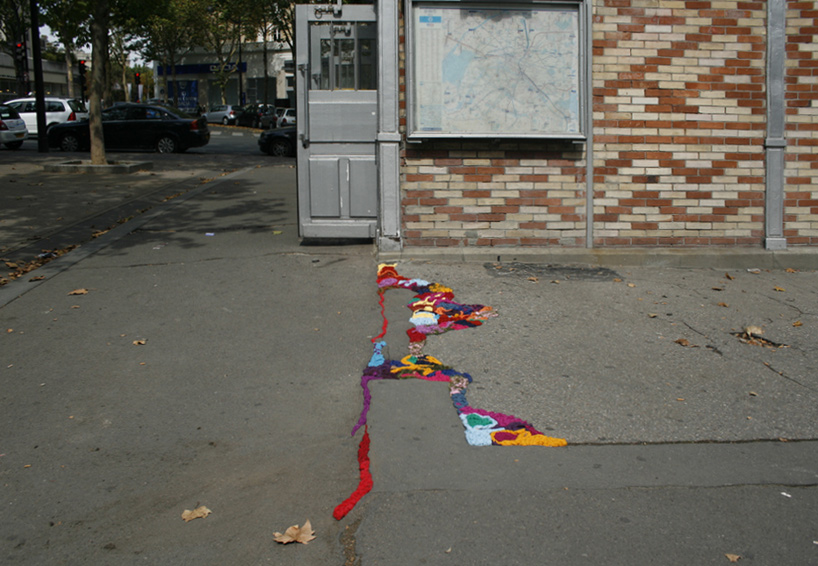
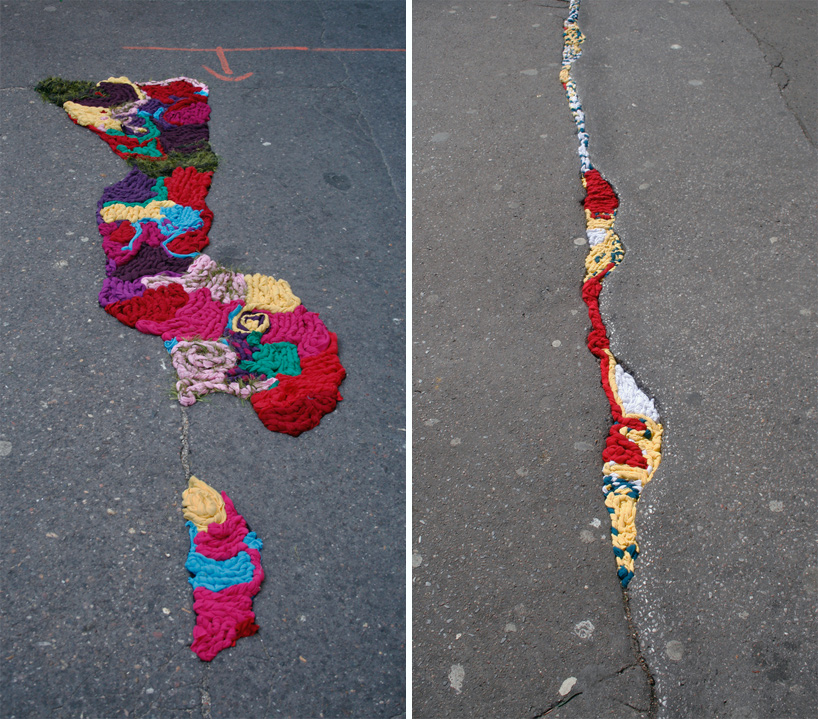
Interventions by parisian based artist juliana santacruz, traces the many cracks and potholes that occur in the city's foundations. By adding braided fabric, she highlights and celebrates the materiality of wear and tear. A nice addition to the everyday grey that sometimes seem to take over our streets.
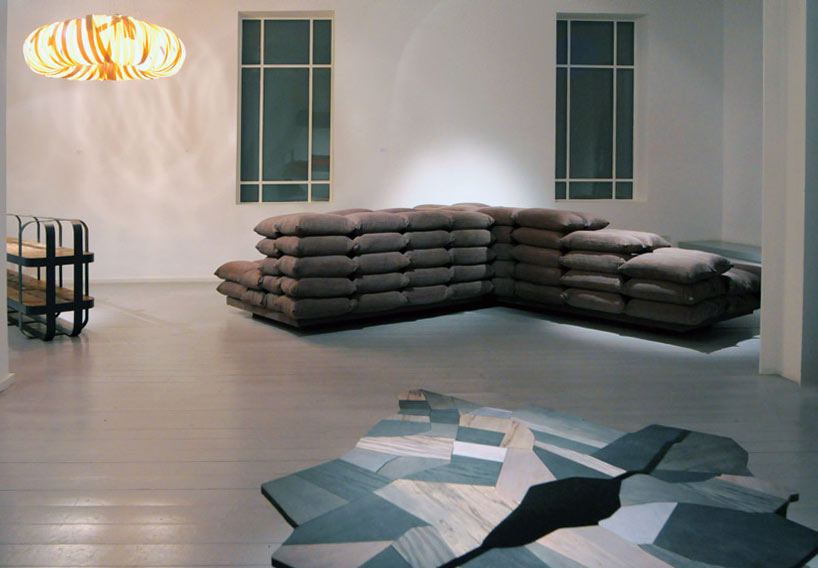
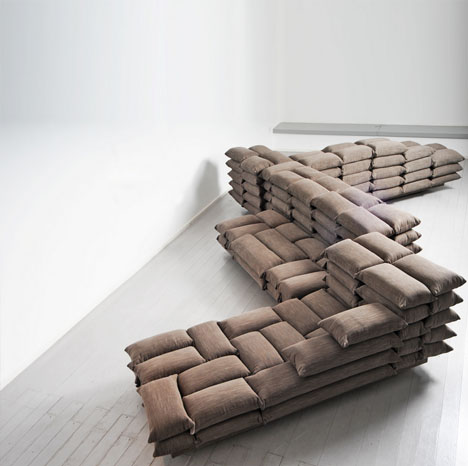
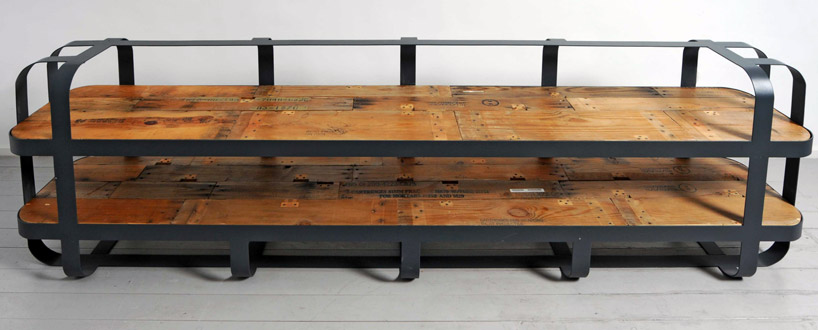
Kalab (close to home) is an exhibition the Paradigma Design Gallery in Tel Aviv Israel by the artist, Ezri Tarazi. (until March 18) It consists of both reclaimed war paraphernalia and mimics thereof that has creatively been remade/made into furnishings. There's a sofa resembling a sandbag fortification, a lamp constructed out of satchel straps, recreating the shape of tires from army trucks, a shelf built out of discarded ammunition boxes.
ammunition box shelf + powder coated iron, image from designboom
Of course, this is still high-end design place in a design gallery but there is an juxtaposition in Tarazi's work. It is based on the memories of a state at war, his childhood and his concern for the future of Israel, as noticed over at designboom and dornob. The designs speaking of the relationship between the military and the civil and how closely related these are within the context of the Israeli/Palestinian conflict. Conflict becoming domesticated when it is carried on for generations.
This is personal and is a retrospective of the designers own life, experiences and feelings. What is interesting to me as a landscape architect is the act of reclaiming materials for the purpose of remaking them into a new functional state of being but still somewhat resembling what it once was, what purpose it served and what memories are attached to it. I am a romantic in this way, and romanticising like this does not speak or reflect the reality of the experiences that somebody from this region would've gone through.
The act of reclaiming materials in the war torn landscape speaks about spatial systems, both the system of warfare and the system of recuperating and rebuilding from it. The system of warfare exhibited in the locations of found objects and the system of rebuilding in the new locations that the materials find themselves in. The objects themselves are framed moments in time but the process behind making/remaking them, speaks about landscape, the time and process of our culture and how we occupy space.
“By its nature, the Internet undermined anyone whose status depended on a privileged access to information.” —Michael M. Lewis, Next: The Future Just Happened
The loveland project has introduced inchvestments of so called microhoods, real urban lots in Detroit, that are made online, so you can say that they are rebuilding Detroit through the internet. (They are even suggesting that you buy inches as gifts) hardcore!
These spaces are located within housing and urban lots that are no longer 'productive', I am guessing that previous commercial and industrial ventures are now long gone as these buildings and lots ceased to be profitable and this obviously would've led to an abandonement in residential lots too. So these 'empty' urban lots have been standing in limbo waiting for somebody to come in and start making use of them. These microhoods are envisioned to be visitable park and garden spaces along with renovated abandonded buildings. Inchvestors buy into a set of inches and then collaborate with other inchowners in their microhood to carve out some fine ideas of what to develop on the sites. In other words, it sounds like the loveland project are creating a new type of public space based on the redundant urban spectacle. This is made possible by an innovative social tool, the internet. Watch the TED talk by founders Jerry Paffendorf and Mary Carter:
“Old ideas can sometimes use new buildings. New ideas must use old buildings."
Jane Jacobs, The Death and Life of Great American Cities
Loveland is a fantastic innovation in urban development and should receive praise on the highest level. Hopefully they can maintain this concept around community based ownership and investment. The danger in rejuvenation through the arts and crafts, through creative endevours is that a gentrification eventuates in those neighbourhoods as the creative lifestyles become fashionable and so you see residential prices shoot through the roof and eventually move the artists elsewhere.
Plymouth, Lovelands first digital/analogue neighbourhood.
The Loveland website as it is formatted looks very digital. I mean, that IS the whole point. But, I guess what I am trying to convey is a need to perhaps start spatialising the incentives and the projects that are forming in the microhoods so that we can understand them more beyond a planning llot that is either square or rectangular and coloured in red, green or yellow. More pictures, more plans, sections etc. would aid in understanding the impact that this DIGITAL system as had on our ANALOGUE reality.
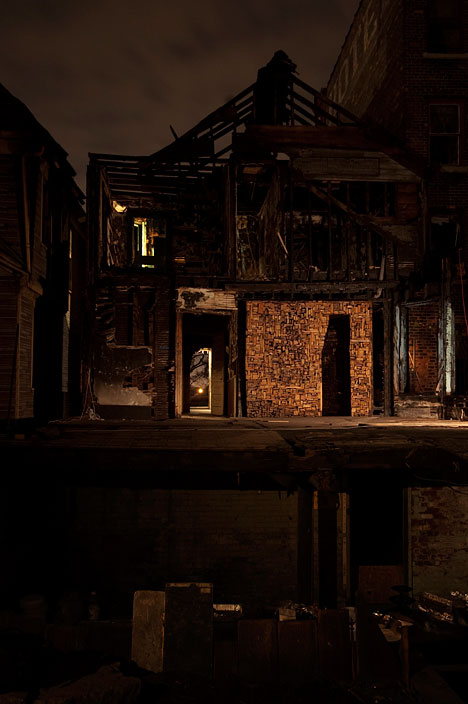
Living in the map is a take on the rather drained and seemingly old expression of community consultation. The idea of traditional paper pushing and prolonged waiting periods due to bureaucratic red tape seem to have been moved aside as the internet provides a platform in redeveloping and rethinking Detroit. Imagination station is behind the Living in the map concept which is a continuation of the loveland project that basically offers people to invest in so called microhoods starting as small as an inch. Living in the map seems to have just been powered up and is a website still in need of some work but the general concept is to act as a social platform for job opportunities and for sharing general information and city data of what is going on in Detroit. Imagination station also thinks up clever reclamation installations and public artworks such as this beautiful piece by Katie Newell called Salvaged Landscape whereby she intervened in a burnt down building and used wood to reconfigure the destructed material and building into a so called passageway.
Sewell is gradually demolishing this building turning it into an intervention in the process. Catie Newell describes it:
Salvaged Landscape appropriates the charred wood from an arsoned house to create spatial adjustments which uncover the material qualities reliant on flame to exist. Amidst a purposeful tear-down, the project responds to the new textures, spaces, and light effects that resulted both from the fire and demolition. Using existing material from the house as the palette and existing spaces as form-work, Salvaged Landscape creates a new room in the life of the house keying into the opportunities present in its own timeline; constructed with the demolition of the house occurring around it
Following insertion of the left-over firewood into the hollows of the savaged structure, the artist will attempt to invert the passageway. She wants to remove the remains of the old building structure and flip the passagewayonto its side so that it becomes an impenetrable structure and a celebration of the building that once was...
As a landscape architect, I see these map mountain artworks by Dutch artist Louis Reith as much more than just a decorative piece. The re-use of existing forms of representation such as the maps can begin to inform a re-design of the sites they were representing in the first place. The map mountains become functional in my eyes. The map models can show or suggest alternative spatial configurations and thus inspire and generate spatial suggestions when designing. via frankie