Showing posts with label art. Show all posts

5/22/2011

String Spectacular

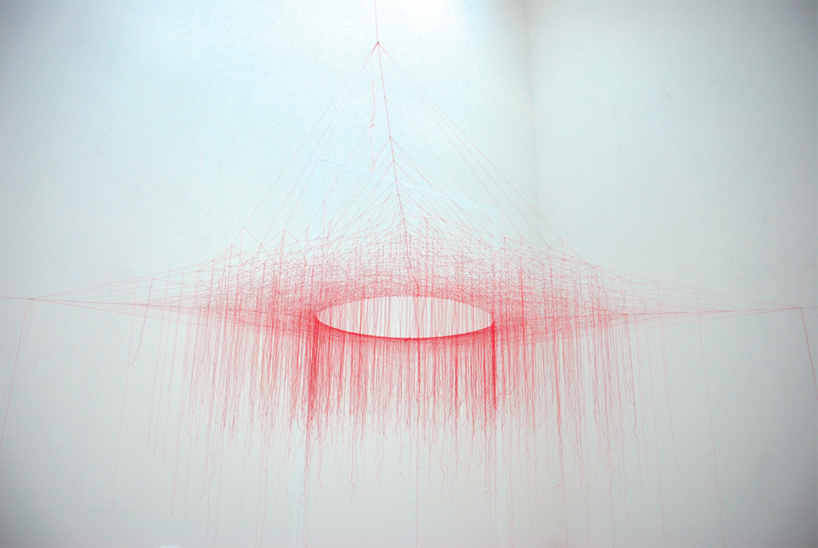
full view, from designboom
Akiko Ikeuchi knots silk thread in a process that takes up to a month for gallery installations. The works are room size scales and the work is so delicate and subtle which I think reflects the process of making it and the personality of the artist. The knots seem to reflect the daily disruptancies that one face, one by one, Ikeuchi documents these experiences into a a narrative of collective moments. One knot is one moment in time, brought together into a story. Stunning.

detail of installation showing the knots, via here


This is a google translation of the artist's own description of the work, from Japanese to English. I believe the translation is not completely accurate but I reckon you still get the just of the intent, in fact, it is very beautiful.


ー four axonemal Azuma Minami northwest respectively, are stretched to the northeast ー southwest.
Yarn and yarn cross connectedness are all tied together with 引合Tsu.

Red is the color of my approach to life and responded to the incident which occurred in the past two years.
Is evidence of every single knot in my day.

It has spanned many times is still tied at first glance, that appears to be strong and stable,
Breaks down quickly once the off-axis yarns.

The world is made up of subtle fragile balance.

                □

"A feeling" came over the fade again.
Kind of vibration?
Words can not.
And narrowed his eyes, threw out - and as you seem to try to slightly roll the brain.
If they disappear quickly enter forcibly separated.

The silk tie by keeping it connected and the sensor.

Some exposure to light and air, see how hiding something that faintly.
That you kept going away before it's light and air inside the right or not.
Because I have that desire to with it.

I believe this particular piece was exhibited at gallery 21 in 2009. 
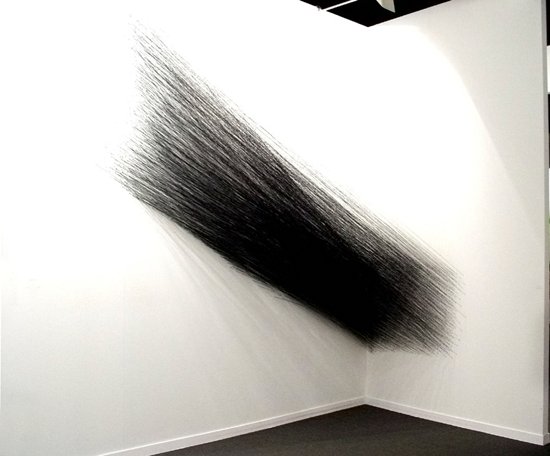
Edith Derdyk, Slice, 2003
4.000 meters of black cotton line, 2.800 stapples and 4 days of setting up
Arco Feira de Arte, Madrid, Spain
photo: Edith Derdyk
To continue on artists that work with string and thread, Brazilian artist Edith Derdyk's work is also absolutely stunning. 


Edith Derdyk, Rasures III, 1998
60.000 meters of black cotton line, 10.000 stapples and 13 days of setting up
City Canibal, curator: Daniela Bousso
Paço das Artes, São Paulo, Brazil
photo: Gal Oppido

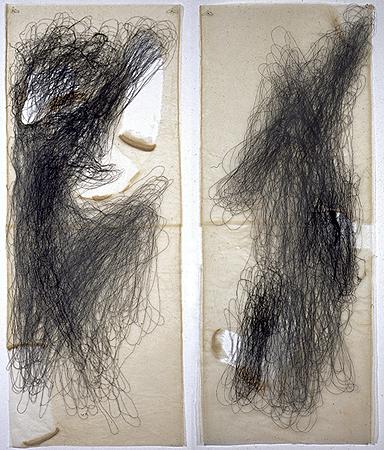
It is the visual intensity and the rigorous process of creating the piece that impress and interest me the most. Derdyk's process begins with drawing and the idea of the line, according to the artist.


Edith Derdyk, Projects and sketches, 1999/2001
Ball-point pen,
paper

Interlineation, 1998
Drawings
Paper, black cotton line, vinyl glue
50 x 180 cm
photo: Rômulo Fialdini
More of Edith Derdyk's work here.

This is quite a full on description of her work by Arnaldo Artunes in his mini essay Cocoon, found here:
It all started with the paper being torn. After drawing for many years, and also after drawing with thread (adding its material meaning to its use – threads made of threads) as if embroidering the surface of the paper, Edith began to open incisions, filling them with blçack thread, in a paradoxical gesture – tearing so that the sewing could appear beneath the tearing) not the sewing of the tearing, but a sewing beneath the teraing), like surgical sutures within the deepest skin layers. The result were organic suggedtions, many times sexual (vaginas, incisions, wounds; the obscenity of interanl hair under the beardless surface of the paper). Then these incisions started to swell, as if the stitches were inflaming. The wounds that Edith had opened, suddenly became tumors, with ever more stretched relieves. Dark bulbs that leaped from within the translucid and delicate skin of the rice paper, with its dark lines keeping something that is always about to leak. As if paper were live bodies, from within which, depending on the depth of the tearing, some sort of guts would have to leap.
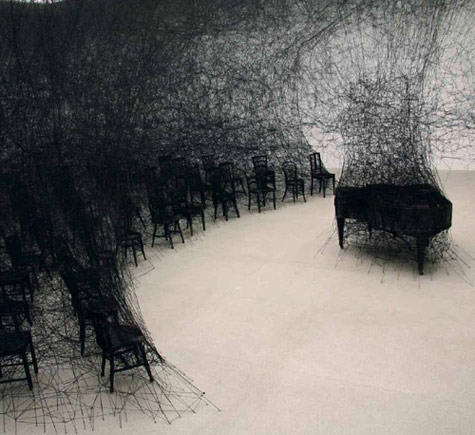
Chiharu Shiota, In silence, 2009 
centrepasquart, biel bienne, switzerland
I have also had a huge crush and massive respect and awe for installation and performance artist Chiharu Shiota, who's work is short of absolutely gobsmackingly spine chillingly god damn spectacular and who recently exhibited at the 'detached' gallery in Hobart that I sadly missed.  Above is a 2009 piece from In silence, a progressive art/installation piece that has been erected and showed at a number of different locations since 2007 when it was part of a performance at the Kanagawa Arts Foundation, in Kanagawa, Japan. (below). Of course, the process of making this space, the setting up and weaving of the wool is of particular interest for me but also the intent of Shiota, who wants to depict the sound of silence in space.Very beautiful.


In Silence, Toshi Ichiyanagi x Unit2007, found here


Chiharu Shiota, "In Silence" (2008). Piano, Chairs, Wool

4/22/2011

Pothole colours

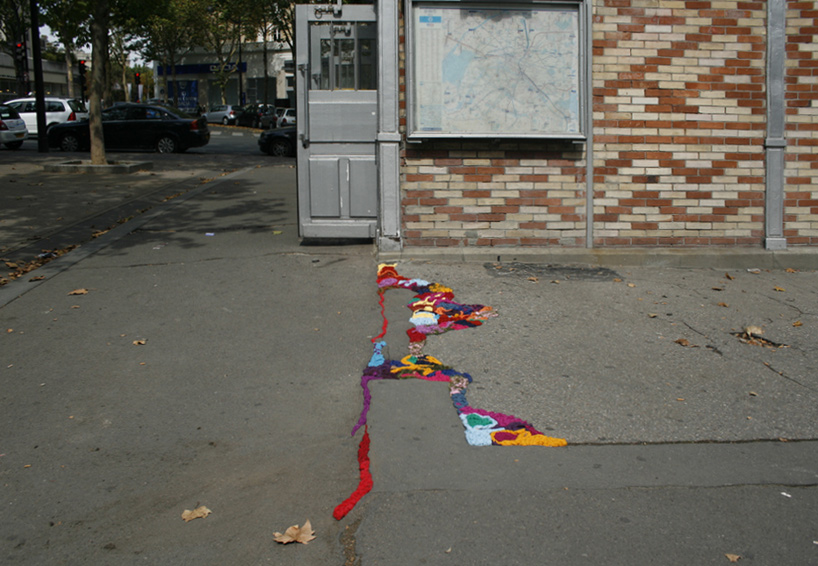
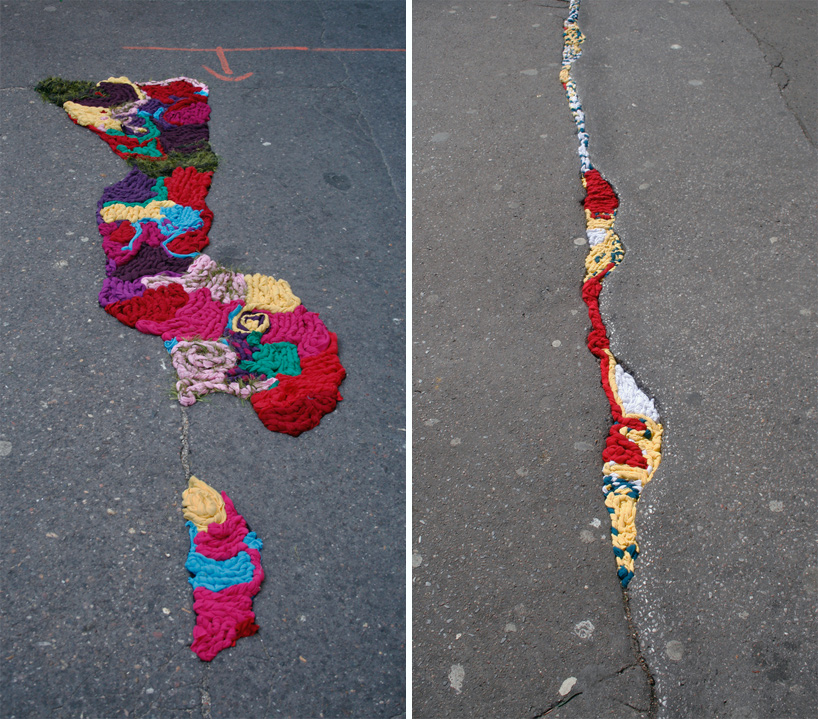
Interventions by parisian based artist juliana santacruz, traces the many cracks and potholes that occur in the city's foundations. By adding braided fabric, she highlights and celebrates the materiality of wear and tear. A nice addition to the everyday grey that sometimes seem to take over our streets.

image via designboom

4/12/2011

Kalab (close to home) - Ezri Tarazi Design Studio

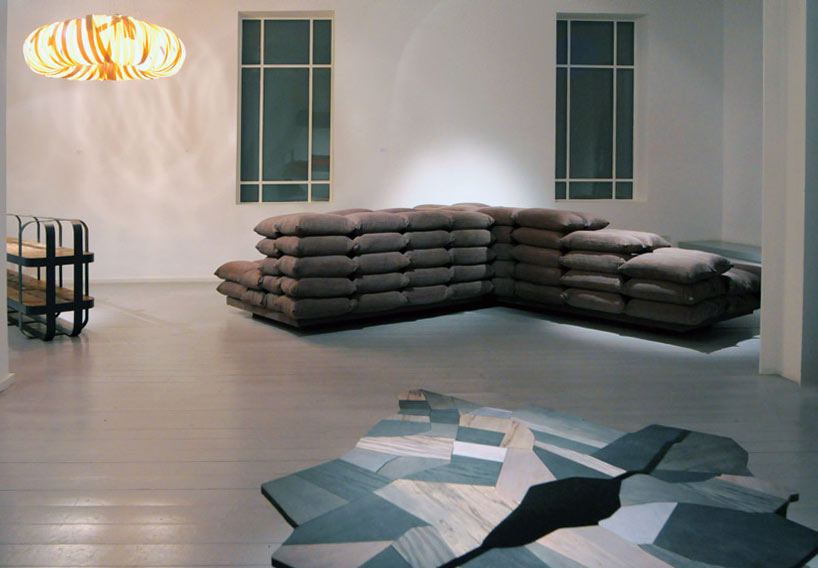
room composition, image from designboom
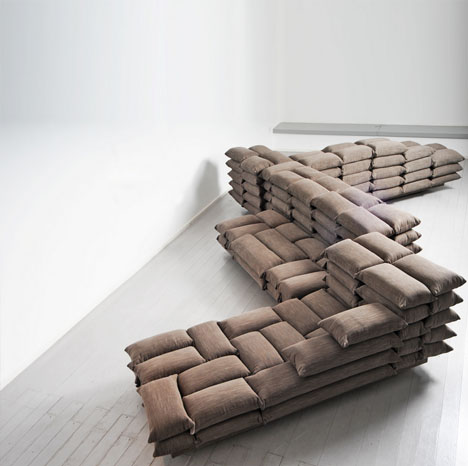
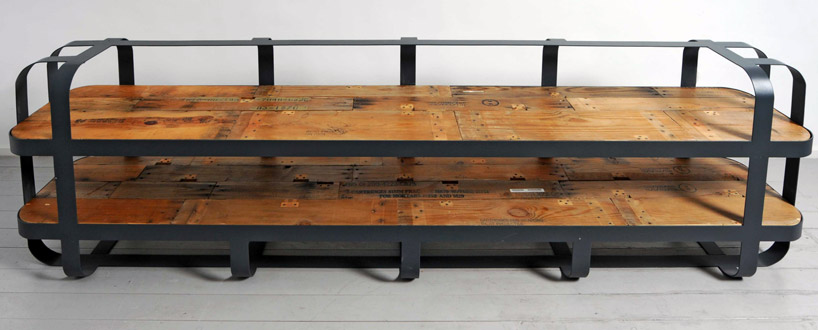
Kalab (close to home) is an exhibition the Paradigma Design Gallery in Tel Aviv Israel by the artist, Ezri Tarazi. (until March 18) It consists of both reclaimed war paraphernalia and mimics thereof that has creatively been remade/made into furnishings. There's a sofa resembling a sandbag fortification, a lamp constructed out of satchel straps, recreating the shape of tires from army trucks, a shelf built out of discarded ammunition boxes.

sandbag sofa, image from dornob


satchel strap lamp, image from tarazi studio

ammunition box shelf + powder coated iron, image from designboom
Of course, this is still high-end design place in a design gallery but there is an juxtaposition in Tarazi's work. It is based on the memories of a state at war, his childhood and his concern for the future of Israel, as noticed over at designboom and dornob. The designs speaking of the relationship between the military and the civil and how closely related these are within the context of the Israeli/Palestinian conflict. Conflict becoming domesticated when it is carried on for generations.

This is personal and is a retrospective of the designers own life, experiences and feelings. What is interesting to me as a landscape architect is the act of reclaiming materials for the purpose of remaking them into a new functional state of being but still somewhat resembling what it once was, what purpose it served and what memories are attached to it. I am a romantic in this way, and romanticising like this does not speak or reflect the reality of the experiences that somebody from this region would've gone through.


The act of reclaiming materials in the war torn landscape speaks about spatial systems, both the system of warfare and the system of recuperating and rebuilding from it. The system of warfare exhibited in the locations of found objects and the system of rebuilding in the new locations that the materials find themselves in. The objects themselves are framed moments in time but the process behind making/remaking them, speaks about landscape, the time and process of our culture and how we occupy space.

4/07/2011

Loveland - Detroit

Salvaged Landscape, inside
Salvaged Landscape passageway


“By its nature, the Internet undermined anyone whose status depended on a privileged access to information.”
—Michael M. Lewis, Next: The Future Just Happened 

The loveland project has introduced inchvestments of so called microhoods, real urban lots in Detroit, that are made online, so you can say that they are rebuilding Detroit through the internet. (They are even suggesting that you buy inches as gifts) hardcore!

These spaces are located within housing and urban lots that are no longer 'productive', I am guessing that previous commercial and industrial ventures are now long gone as these buildings and lots ceased to be profitable and this obviously would've led to an abandonement in residential lots too. So these 'empty' urban lots have been standing in limbo waiting for somebody to come in and start making use of them. These microhoods are envisioned to be visitable park and garden spaces along with renovated abandonded buildings. Inchvestors buy into a set of inches and then collaborate with other inchowners in their microhood to carve out some fine ideas of what to develop on the sites. In other words, it sounds like the loveland project are creating a new type of public space based on the redundant urban spectacle. This is made possible by an innovative social tool, the internet. Watch the TED talk by founders Jerry Paffendorf and Mary Carter:


“Old ideas can sometimes use new buildings. New ideas must use old buildings."  
Jane Jacobs, The Death and Life of Great American Cities

Loveland is a fantastic innovation in urban development and should receive praise on the highest level. Hopefully they can maintain this concept around community based ownership and investment. The danger in rejuvenation through the arts and crafts, through creative endevours is that a gentrification eventuates in those neighbourhoods as the creative lifestyles become fashionable and so you see residential prices shoot through the roof and eventually move the artists elsewhere. 

Plymouth, Lovelands first digital/analogue neighbourhood.
The Loveland website as it is formatted looks very digital. I mean, that IS the whole point. But, I guess what I am trying to convey is a need to perhaps start spatialising the incentives and the projects that are forming in the microhoods so that we can understand them more beyond a planning llot that is either square or rectangular and  coloured in red, green or yellow. More pictures, more plans, sections etc. would aid in understanding the impact that this DIGITAL system as had on our ANALOGUE reality.

for more images, go to core77
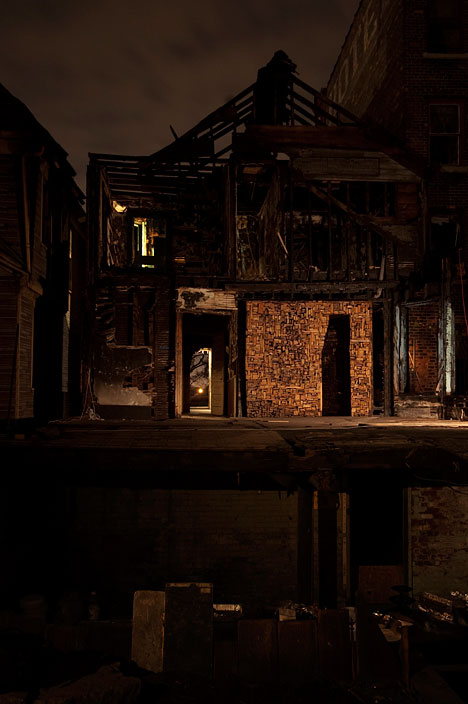
Living in the map is a take on the rather drained and seemingly old expression of community consultation. The idea of traditional paper pushing and prolonged waiting periods due to bureaucratic red tape seem to have been moved aside as the internet provides a platform in redeveloping and rethinking Detroit. Imagination station is behind the Living in the map concept which is a continuation of the loveland project that basically offers people to invest in so called microhoods starting as small as an inch. Living in the map seems to have just been powered up and is a website still in need of some work but the general concept is to act as a social platform for job opportunities and for sharing general information and city data of what is going on in Detroit. Imagination station also thinks up clever reclamation installations and public artworks such as this beautiful piece by Katie Newell called Salvaged Landscape whereby she intervened in a burnt down building and used wood to reconfigure the destructed material and building into a so called passageway.


more on the Salvaged Landscape project here
Sewell is gradually demolishing  this building turning it into an intervention in the process. Catie Newell describes it:  

Salvaged Landscape appropriates the charred wood from an arsoned house to create spatial adjustments which uncover the material qualities reliant on flame to exist. Amidst a purposeful tear-down, the project responds to the new textures, spaces, and light effects that resulted both from the fire and demolition. Using existing material from the house as the palette and existing spaces as form-work, Salvaged Landscape creates a new room in the life of the house keying into the opportunities present in its own timeline; constructed with the demolition of the house occurring around it

Following insertion of the left-over firewood into the hollows of the savaged structure, the artist will attempt to invert the passageway. She wants to remove the remains of the old building structure and flip the passageway onto its side so that it becomes an impenetrable structure and a celebration of the building that once was...

3/27/2011

Barbara Í Gongini


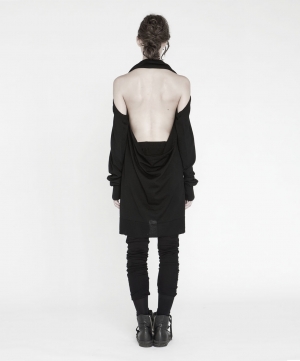
Beautifully dark gothic/pixie/fairy style clothing. I am a big fan of garments that seem to have neither beginning nor end to its form. Barbara Í Gongini creates this. With freeflowing and flattering pieces that can be worn in multiple ways. Her garments wrap around/under/over/unbutton/button and so on...

Also, along with a creative team,  Í Gongini produce the most magic and haunting fashion videos. Inspired perhaps by the Japanese horror movies The Ring and The Grudge. Garments come alive when you choreograph seemingly unnatural human poses and movements. It gives me shivers at the same time as I find it fascinating and rather sexy. I WILL own a Barbara Ingongini garment...and I am also inspired to make my own Barbara Í Gongini influenced clothing.

via cool hunting

via cool hunting

long chalk jacket
Middle length cardigan, with detachable sleeves.

Middle length cardigan, with detachable sleeves

Middle length cardigan, with detachable sleeves

Middle length cardigan, with detachable sleeves

3/26/2011

Die Antwoord - short film - Bring me my machine gun or Umshini Wami (zulu)

I have been following Die Antwoord now for over a year since one of my former studio members introduced them to me with the question - Are they serious?

Since then Die Antwoord has quickly hit mainstream with their white trash saffa, foulmouthed techno hiphop shit on the next level. I like Die Antwoord because there are more to them than meets the eye. A lot of people think that they are taking the piss. YES THEY ARE PEOPLE....and this is a great thing. The beauty of Yolandi and Ninja is that they are taking the piss out of things in their world, far removed from many of ours.

They are opening doors or windows, if you like, into their way of life, their unique experiences and ultimately and most importantly, a side of South Africa that the western world rarely see.

This movie is no different. There are still some serious issues in South Africa. The title of this movie is Umshini Wam, in Zulu this means 'Bring me my machine gun'. It is also known as a struggle song and is widely known as the ANC's military wing during the apartheid struggle. It has recently been linked to the current president of South Africa, Jacob Zuma and is still sung in rallies and demonstrations throughout the country.

I think this is the understatement of the movie. It seems as if many people in South Africa still haven't learnt the lesson from the violence associated with apartheid. To have this type of mentality, that of a dominant colour, within the so called rainbow nation obviously creates some serious social divides. To me, this movie seem to have a message about a social divide and the still evident prejudices and racism that goes on within SA's borders. 

Yes, I believe that, of course, the movie could be done in another way, but this way is full on and maybe that is what is needed to start a discussion about this issue. A little bit of humour, some phat beats by DJ Hitec and a lot of swearing hits home with me.

3/23/2011

Louis Reith and map mountains


As a landscape architect, I see these map mountain artworks by Dutch artist Louis Reith as much more than just a decorative piece. The re-use of existing forms of representation such as the maps can begin to inform a re-design of the sites they were representing in the first place. The map mountains become functional in my eyes. The map models can show or suggest alternative spatial configurations and thus inspire and generate spatial suggestions when designing. via frankie
Related Posts Plugin for WordPress, Blogger...