Showing posts with label installations. Show all posts

10/31/2012

Memories and carving pumpkins


 How do you celebrate Halloween?

In Sweden where I grew up, November 1st, is a day where you send a thought to loved ones that have passed away and you often visit their graves, put some plants and light a candle in their memory. I remember going with my grandmother to my grandfathers grave at the Eastern Cemetary in Malmo each year, and often also going to my paternal great grandmothers grave straight afterwards, to say a silent hello and to remember their life with us.

Östra kyrkogården Malmö, from here

But more so, what is really more prevalent in my mind is the memory of feelings and sensations I got when entering this particular cemetery in late Swedish autumn. Often a rugged, cold and wet afternoon with not much sunlight, the remnants of once colourful leaves now turning brown on the ground as the photosynthesis gradually removes the chlorophyll from its veins. Muddled conversations from dark figures hunching over the graves of their forefathers, warm air blowing from their mouths as they say their hellos, how are yous and goodbyes. The flickering light from hundreds of individual candles that have been gently placed on each grave from somebody that needs to remember. A wet and stubborn runny nose turning red as the cold bites harder as darkness and evening sets in. The trees are almost naked now and the evergreen shrubbery and hedges line the grave divisions strictly ordering the system of the dead.
The sombre atmosphere is something that I treasure in my heart and in my memory. Tradition makes it happen and the landscape makes you feel it. 

from here


This way of celebrating Halloween predates the Christian church and is actually linked to Pagan Rituals of guiding the dead. The pagans believed that when summer was finished the dead returned home and needed people to light their way with fires, hence the lighting of candles, decorating and visiting of graves in modern time.
Here in Australia, I don’t quite know how it would feel like to experience the cemetery, tonight on the eve of the dead. I don’t know any dead people here. Although, being a landscape architect, I have of course wandered the aisles of many of the local cemeteries on days off but never on this night.
It would be such a different experience. First of all, we are going into summer here in Australia, so it would be warmer, perhaps more humid or dry, the mist, the wet air that is the fairy dance in the northern hemisphere is likely to be dust cloud from the gravel path here in the south, hovering slightly above the ground. Generally, my experience has been that the vegetation around the Australian cemeteries tend to be quite arid and bushy/thorny, almost like the dead themselves. They are not designed for grand displays of planting schemes; neither do they seem to be public spaces used beyond their primary program. But I haven’t seen them all, so I couldn’t possibly tell you that all of them are like this.


Östra kyrkogården Malmö, from here

Östra kyrkogården Malmö, from here


Commercially, Halloween to me is a pumpkin, little kids begging for sweets and money, horror on the television and a good excuse for grown up dress up parties and frolicking around.
Yes, I admit it. I bought a pumpkin solely on the premise that I’d get to carve into it and turn it into a scary looking piece of home decoration for a couple of nights in our house lit up with tea candles.

this years pumpkin

Buying a pumpkin and sitting down to watch Tim Burton’s Nightmare Before Christmas in candle light is as far as I get to celebrate the eve of the dead’s return to our earth this year as my two little darlings need their mum for bedtime.

Spiritually, I am sending thought to loved ones now passed. May they proceed in peace through the landscapes of memory.


9/15/2011

Bottom-up urbanism at its finest - Heath Nash at HIFA 2011

Recycle plastic bottle pattern - Image via designboom courtesy of Heath Nash
 This project includes all the things that I love about design and more specifically about the urban landscape and meaningful spatial site interventions. Heath Nash, project coordinator and designer produced and organised this work along with local artisans for Harare International Festival of the Art. HIFA performing arts festival 2011. The South-African designer, reused thousands of recycled plastic bottles and other materials such as plastic buckets and aluminium cans to create a set of canopies for the urban dweller to take to when in need of shade. According to designboom, Nash got the inspiration from simply walking the streets of the Zimbabwean capital whilst observing how people occupied and congregated under the city's tree canopies so to avoid the Southern African mercury. 
This observation was translated into a pragmatic and spatial take on the idea of recycling waste materials derived from consumption. 

Components of an extensive distribution system - Image via designboom courtesy of Heath Nash


The way in which the canopies are constructed is simply magic. Repetitive pattern is one of the most powerful ways of generating beauty and striking form in my eyes and the combining of cultural and social observation with a commentary of mass-consumption, leads way to a meaningful site intervention.

The project suggests a site intervention that is constructed at a 1:1 scale, utilising local craftsmanship with the organising mind of a designer. The other beauty in this project lie in the system that this 1:1 site intervention actually represents. Where all these bottles, cans and buckets come from remain unrepresented, perhaps it is not doable but I hope that you get the picture. A 1:1 intervention that assembles tens of thousands of small objects that was part of a mass-distribution system going out for consumption to then be returned to another system, that of recycling and end up in this meaningful installation. Simply beauty.

re-ordering, re-assembling, re-configuring - Image via designboom courtesy of Heath Nash
process - Image via designboom courtesy of Heath Nash

7/10/2011

Ebony Bizys - Everyday Tokyo

These photos by graphic designer Ebony Bizys are just the type of everyday landscape that I am researching for my own design projects.

I love how this landscape of pots and interior furniture and fittings represents ordinary everyday life of the city's inhabitants and their desire to make a mark on their surroundings. Claiming a little bit of space, growing, nursing and caring for a little bit of life, a small scale intervention in a 21st century large scale city. You might want to check out: urban interior, a group of researchers based in Melbourne that recently released a book exploring the idea of urban interior.

image via otherpeopleshouses

image via otherpeopleshouses

image via hellosandwich

image via hellosandwich

7/08/2011

Roskilde wee tree pee

p-tree by Aandeboom, via dezeen


I LOVE the Roskilde festival, I used to religiously go every summer back in my teens and I LOVE this clever urinal solution by dutch designers Aandeboom. I guess the only criticism I have with this intervention is: how will the ladies go with it? I guess in the state that I put myself in on these festivals, personal space is sort vanished anyway, bloody heck, I used to shower butt naked with thousands of people and nobody frowns upon it, so perhaps this critique doesn't belong here?

The urinal can be connected to the main sewer system or a tank via pump. I guess if it was a lemon tree that wouldn't be necessary because apparently the thrive in a p-environment. (do not take this too seriously tho)

Although, it would be nice to see a picture of a female using this.


p-tree by Aandeboom, via dezeen

p-tree by Aandeboom, via dezeen

7/06/2011

Bird Hotel not in trees

bird cafe by Teddy Luong and Dennis Cheng for Umbra

via designmilk
This is a nice little design but I can't help pondering the designing of the birds actual habitat in the form of trees. The spatial qualities would improve with the planting of trees and shrubs instead or in addition to.

Unless, of course, you designed this little bird house for an urban installation. It has a quicker impact on the site than waiting for a tree to grow. So here it is: install this little bird house design whilst you wait for their actual tree/shrub habitat to grow in the meantime. Greatness!

6/20/2011

State of Design 2011 Festival Guide - Now available

This years State of Design festival guide has been launched and is available from their website, here.

The theme for this year's festival is Design that moves. Personally, I am interested in the interventions that take place outside in the urban fabric, such as the Landscape Urbanism 72 Hour Urban Action in the Docklands that sees teams of architects, builders, landscape architects, urban designers etc...live, eat, sleep and work on their chosen sites and construct new urban forms through site specific interventions. (Correction, the name of this event has now changed to Urban Realities, Landscape Urbanism 3 Day Design Challenge.

Chasing Kitsune, from here

Hassell's Chasing Kitsune which is a Japanese food truck that will make its way around the city and adapt to its imnmediate surroundings, Mapping the Burbs, which is an Architectural discovery tour conducted on your bike.
 Camp Street CampOut + LookOut, which invites you to design and recreate the tent city for a day. Participants are invited to pitch their designs for a tent and display it in Alfred Deakin Place, Ballarat. Using recycled fabric, everyone is invited to tailor their tent claim a little bit of this public space.

Other than what's happening outside on our streets and beyond and true to my personal interests, there is also a worshop called MakeUp which takes you through the art of reusing and upcycling material. From transforming unwanted vintage wallpaper to reusing old yacht sailcloths and turning them into teepees.

This and much much more stuff to do in Victoria from the 20-31 July 2011.

6/16/2011

Urban Interventions

My urban intervention Crate[or] is now online for your perusal here. Feel free to email or comment on the project. It forms a part of ongoing design research that I am conducting into approaching the city at a human scale when discussing urban development and the understanding of the forces that play out in the city.

Crate[or], photo by author

5/22/2011

String Spectacular

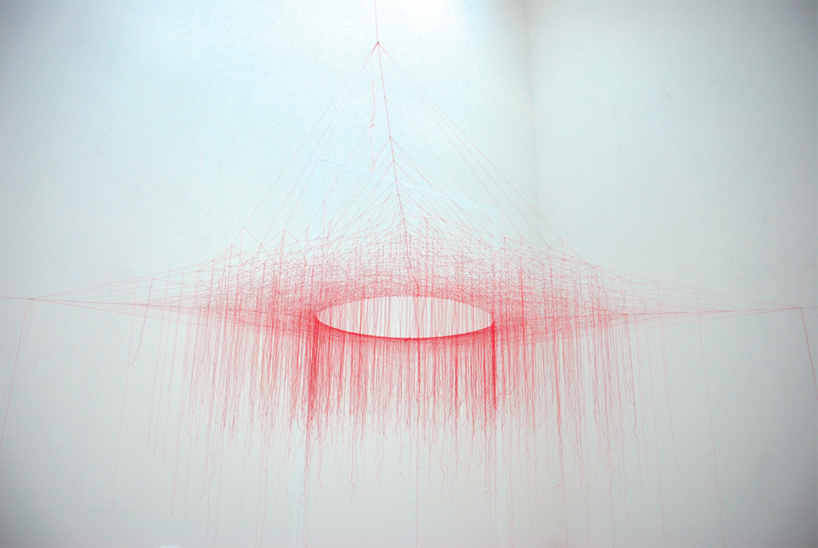
full view, from designboom
Akiko Ikeuchi knots silk thread in a process that takes up to a month for gallery installations. The works are room size scales and the work is so delicate and subtle which I think reflects the process of making it and the personality of the artist. The knots seem to reflect the daily disruptancies that one face, one by one, Ikeuchi documents these experiences into a a narrative of collective moments. One knot is one moment in time, brought together into a story. Stunning.

detail of installation showing the knots, via here


This is a google translation of the artist's own description of the work, from Japanese to English. I believe the translation is not completely accurate but I reckon you still get the just of the intent, in fact, it is very beautiful.


ー four axonemal Azuma Minami northwest respectively, are stretched to the northeast ー southwest.
Yarn and yarn cross connectedness are all tied together with 引合Tsu.

Red is the color of my approach to life and responded to the incident which occurred in the past two years.
Is evidence of every single knot in my day.

It has spanned many times is still tied at first glance, that appears to be strong and stable,
Breaks down quickly once the off-axis yarns.

The world is made up of subtle fragile balance.

                □

"A feeling" came over the fade again.
Kind of vibration?
Words can not.
And narrowed his eyes, threw out - and as you seem to try to slightly roll the brain.
If they disappear quickly enter forcibly separated.

The silk tie by keeping it connected and the sensor.

Some exposure to light and air, see how hiding something that faintly.
That you kept going away before it's light and air inside the right or not.
Because I have that desire to with it.

I believe this particular piece was exhibited at gallery 21 in 2009. 

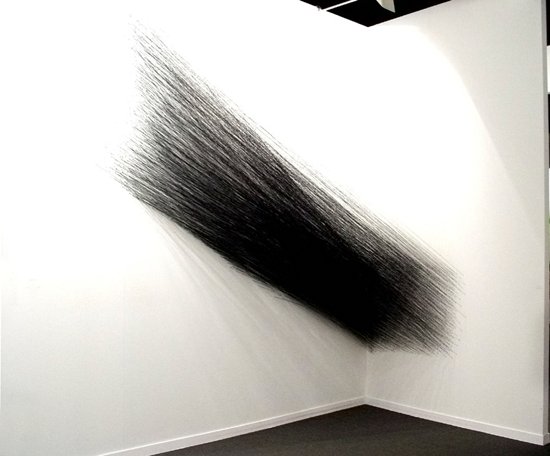
Edith Derdyk, Slice, 2003
4.000 meters of black cotton line, 2.800 stapples and 4 days of setting up
Arco Feira de Arte, Madrid, Spain
photo: Edith Derdyk
To continue on artists that work with string and thread, Brazilian artist Edith Derdyk's work is also absolutely stunning. 


Edith Derdyk, Rasures III, 1998
60.000 meters of black cotton line, 10.000 stapples and 13 days of setting up
City Canibal, curator: Daniela Bousso
Paço das Artes, São Paulo, Brazil
photo: Gal Oppido

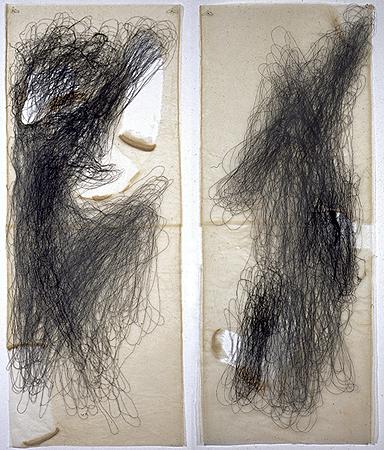
It is the visual intensity and the rigorous process of creating the piece that impress and interest me the most. Derdyk's process begins with drawing and the idea of the line, according to the artist.


Edith Derdyk, Projects and sketches, 1999/2001
Ball-point pen,
paper

Interlineation, 1998
Drawings
Paper, black cotton line, vinyl glue
50 x 180 cm
photo: Rômulo Fialdini
More of Edith Derdyk's work here.

This is quite a full on description of her work by Arnaldo Artunes in his mini essay Cocoon, found here:

It all started with the paper being torn. After drawing for many years, and also after drawing with thread (adding its material meaning to its use – threads made of threads) as if embroidering the surface of the paper, Edith began to open incisions, filling them with blçack thread, in a paradoxical gesture – tearing so that the sewing could appear beneath the tearing) not the sewing of the tearing, but a sewing beneath the teraing), like surgical sutures within the deepest skin layers. The result were organic suggedtions, many times sexual (vaginas, incisions, wounds; the obscenity of interanl hair under the beardless surface of the paper). Then these incisions started to swell, as if the stitches were inflaming. The wounds that Edith had opened, suddenly became tumors, with ever more stretched relieves. Dark bulbs that leaped from within the translucid and delicate skin of the rice paper, with its dark lines keeping something that is always about to leak. As if paper were live bodies, from within which, depending on the depth of the tearing, some sort of guts would have to leap.
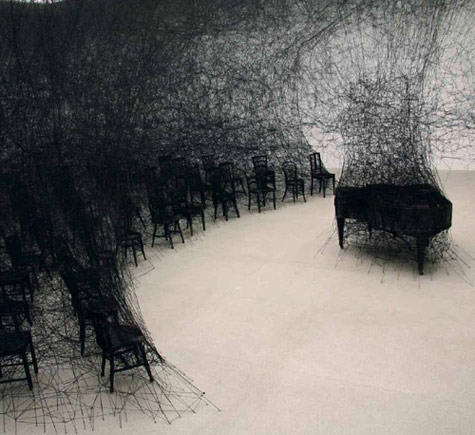
Chiharu Shiota, In silence, 2009 
centrepasquart, biel bienne, switzerland
I have also had a huge crush and massive respect and awe for installation and performance artist Chiharu Shiota, who's work is short of absolutely gobsmackingly spine chillingly god damn spectacular and who recently exhibited at the 'detached' gallery in Hobart that I sadly missed.  Above is a 2009 piece from In silence, a progressive art/installation piece that has been erected and showed at a number of different locations since 2007 when it was part of a performance at the Kanagawa Arts Foundation, in Kanagawa, Japan. (below). Of course, the process of making this space, the setting up and weaving of the wool is of particular interest for me but also the intent of Shiota, who wants to depict the sound of silence in space.Very beautiful.


In Silence, Toshi Ichiyanagi x Unit2007, found here


Chiharu Shiota, "In Silence" (2008). Piano, Chairs, Wool

Related Posts Plugin for WordPress, Blogger...